Inside the model
hachi machi is based on a deep learning architecture described by Alex Graves in his 2013 paper, Generating Sequences With Recurrent Neural Networks, which he uses to generate text and hand-writing sequences. At its core, it consists of two types of neural networks connected to each other: a Long Short-Term Memory (LSTM) network, and Mixture Density Network (MDN).
Long Short-Term Memory
A Long Short-Term Memory (LSTM) is a type of recurrent neural network, or RNN, which allows the model to learn from sequential data, and consider not just the current input but also learn a representation of the history of past inputs, as a way to predict what the next step should be. However, since LSTMs produce a point estimate rather than a probability distribution over possible outputs, they have limited use in generative contexts where variation and unpredictability are desirable.
Mixture Density Network
Mixture Density Networks are models that learn to output the parameters of a Gaussian mixture model—a weighted combination of normal distributions—such that the probability of the target output is high
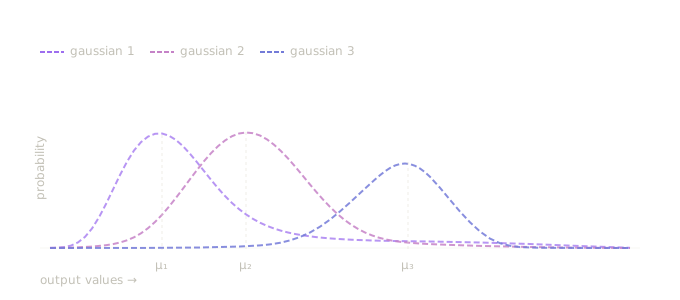
One of the parameters we get to specify in our models is the number of Gaussians the model can learn. In the context of our LSTM-MDN architecture, a somewhat simplistic way to think about it is that it determines how many possible paths the model can take given some input to make the next prediction. Intuitively, more mixtures allow the model to approximate more complex distributions, capturing a wider variety of patterns in the training data.
As such, the main parameters we can provide during training, via the train command, that directly affect the number of model parameters or weights, are:
--mixtures: The number of Gaussian mixtures in the MDN—i.e., how many fuzzy decision branches should the model learn.--hidden-size: The dimensionality of the LSTM's hidden state vector at each timestep—i.e., the capacity of the model's learned representation at each step in the sequence.--layers: The number of sequential layers for the LSTM. More layers allow the model to learn sequences hierarchically, though it may also increase the risk of overfitting and training instability, with diminishing returns beyond a certain depth.